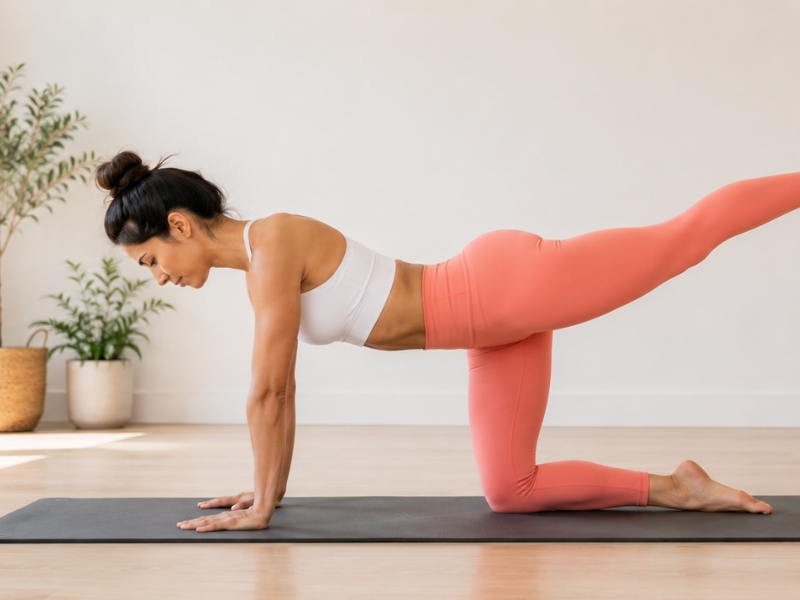
Most people rotate through the same three or four glute exercises indefinitely. The glutes adapt quickly and progress stalls — not because of effort but because of repetition.
→ See how 36 glute-specific movements are structured into a complete training plan
The number of glute-specific movements available is far larger than most training programs suggest — and the variety isn’t just for novelty. Different exercises target different parts of the glute muscle in ways that a small rotation of movements simply cannot replicate.
Why the Glutes Need Exercise Variety
The glutes are three separate muscles — gluteus maximus, medius and minimus — each responding to different movement patterns. No single exercise targets all three effectively and no small group of exercises covers all the stimulus the glutes need to fully develop.
When the same movements are repeated session after session the glutes adapt to that specific stimulus. Adaptation is the enemy of progress. The muscle becomes efficient at those movements rather than continuing to grow in response to them.
Introducing new movements — particularly ones that work the glutes in different planes and through different ranges of motion — creates fresh stimulus that breaks through adaptation and drives continued development.
What EMG Research Shows About Exercise Selection
EMG research measures muscle activation during exercise and the findings consistently show significant variation between exercises in how much glute activation they produce.
Hip thrusts, glute bridges and cable kickbacks score among the highest for gluteus maximus activation. Lateral band walks, fire hydrants and clamshells score highest for gluteus medius. Rotational movements target the gluteus minimus in ways that sagittal plane exercises barely reach.
This means exercise selection is not interchangeable. Swapping one squat variation for another produces a similar stimulus. Swapping a hip thrust for a lateral band walk produces a completely different one — targeting a different muscle through a different plane of motion.
→ See the full list of glute-specific movements and how they’re organized by muscle and plane
Home and Gym Versions of Every Movement
One of the practical challenges with glute-specific training is that many people assume equipment is required. It isn’t.
The majority of high-activating glute exercises can be performed with bodyweight alone or with a basic resistance band. Hip thrusts, glute bridges, donkey kicks, fire hydrants and lateral band walks all require minimal or no equipment and all score highly on glute activation research.
Having both bodyweight and resistance options for each movement means the program works whether you train at home or in a gym — and you never have a reason to skip a session because equipment isn’t available.
Sources: Journal of Applied Biomechanics — Gluteal Muscle Activation During Common Therapeutic Exercises · Journal of Strength and Conditioning Research — EMG Analysis of Glute Exercises · Healthline — Best Glute Exercises According to Science
This article is for informational purposes only and is not medical advice. Always consult a qualified health professional before starting a new exercise program.