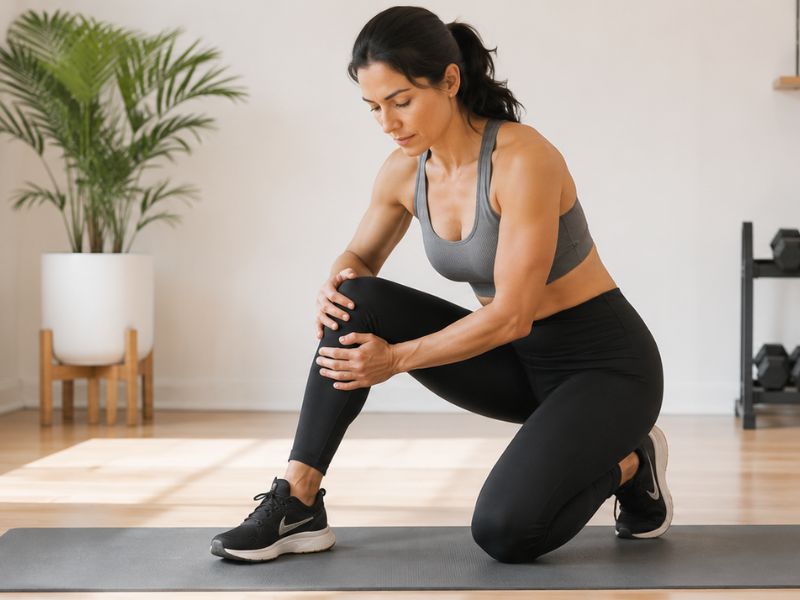
Most sports injuries get treated where the pain is. The knee gets iced, the hip gets stretched, the IT band gets foam rolled. What rarely gets addressed is why those injuries keep happening — and for a surprising number of people, the answer traces back to the glutes.
→ See how building stronger, properly activated glutes supports injury prevention
Weak glutes don’t just limit your training results. They create structural instabilities that show up as injuries in the joints and muscles around them — often far from the glutes themselves.
How Weak Glutes Create Injury Risk
The glutes are the primary stabilizers of the pelvis and hip during movement. When they’re weak or not firing properly that stabilization fails — and the body compensates by loading the surrounding structures instead.
The gluteus medius specifically controls pelvic stability during single-leg movements like running, walking and climbing stairs. When it’s underactive the pelvis drops on the unsupported side with every step. That repeated dropping creates abnormal stress at the knee, the hip and the lower back — producing the kind of overuse injuries that seem to come out of nowhere after months of normal training.
Research consistently links gluteus medius weakness to IT band syndrome, patellofemoral pain, hip bursitis and hamstring strains. These are treated as separate conditions but they often share a common upstream cause.
The Injuries That Point Back to the Glutes
IT band syndrome — the lateral knee pain that plagues runners — is strongly associated with hip abductor weakness, which includes the gluteus medius. When the hip can’t stabilize properly the IT band is forced to do that job and the friction at the knee follows.
Hamstring strains frequently occur when the glutes aren’t firing as the primary hip extensor. The hamstrings compensate and take on a load they aren’t built to handle repeatedly. The result is a hamstring that keeps getting strained even after it heals — because the underlying compensation pattern was never addressed.
Knee pain from patellar tracking issues often traces back to weak hip abductors allowing the femur to rotate inward, pulling the kneecap off its optimal path. Strengthening the gluteus medius is one of the first interventions physical therapists use for this exact reason.
Why Treating the Injury Isn’t Enough
The pattern here is consistent. An injury is treated, heals, and returns — because the structural weakness that caused it was never corrected. The knee is treated but the hip is ignored. The hamstring is rested but the glutes are never trained to take over the load they were always supposed to carry.
Training the glutes specifically — not just including them incidentally in compound movements — addresses the root of many of these recurring injury patterns. It doesn’t replace medical treatment for acute injuries. But for people who experience the same injuries repeatedly with no clear explanation, the glutes are almost always worth examining first.
Sources: Clinical Journal of Sport Medicine — Hip Muscle Weakness and Overuse Injuries in Recreational Runners · Iowa Orthopaedic Journal — Gluteus Medius Tendon Rupture as a Source for Back Buttock and Leg Pain · Podiatry Today — How Core and Glute Muscles Affect the Lower Extremity
This article is for informational purposes only and is not medical advice. Always consult a qualified health professional before starting a new exercise program.