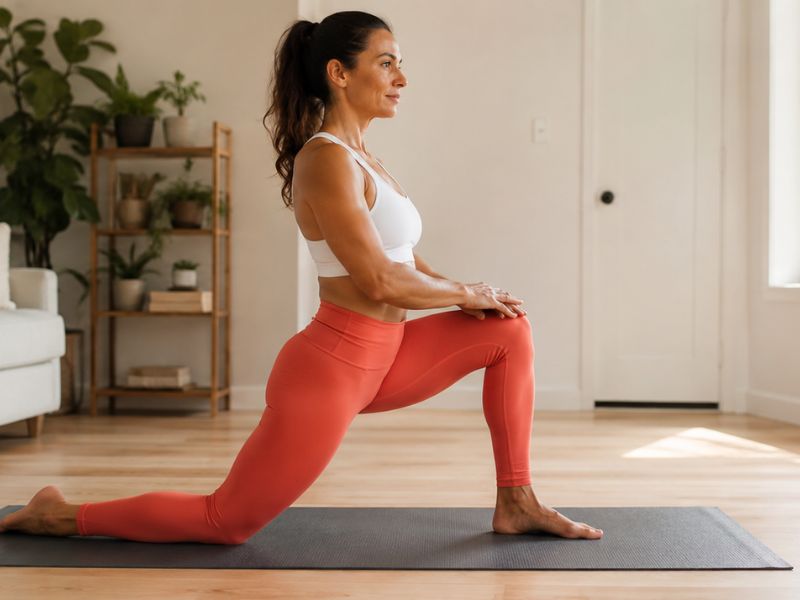
You can do every glute exercise in the book and still get almost nothing from your glutes — and tight hip flexors are often the reason nobody tells you about.
→ See how addressing hip flexors is built into this glute training approach
It’s not a flexibility problem. It’s a mechanical one — and until it’s fixed, your glutes physically cannot contract the way they need to.
The Hip Flexor-Glute Relationship
Your hip flexors and glutes are opposing muscle groups. When one contracts the other lengthens. That’s how the body is designed to work.
The problem is what happens when you sit for extended periods. Sitting keeps your hip flexors in a shortened, contracted position for hours at a time. Over days, weeks and years of this, they stay there — even when you stand up, even when you work out.
A shortened hip flexor creates a constant pull on the pelvis, tilting it forward. In this position your glutes are already partially lengthened before you even begin an exercise. They can’t reach full contraction. The muscle is working against a structural disadvantage before a single rep is done.
Why This Explains a Lot
If you’ve ever done a set of hip thrusts or glute bridges and felt almost nothing in your glutes — this is frequently why. The movement is technically correct. The exercise is the right choice. But the hip flexors are so tight they’re physically preventing the glutes from doing their job.
This also explains why some people feel glute exercises immediately in their lower back instead. When the glutes can’t contract fully the lower back compensates. It’s not poor form causing the problem — it’s a restriction that form alone can’t fix.
→ See the two-step approach that addresses hip flexors before glute training begins
The Fix Has to Come First
The key word there is before. Addressing tight hip flexors isn’t something you work around during a session — it’s something that needs to happen before the session starts.
Lengthening the hip flexors first removes the mechanical brake on the glutes. Once that restriction is released the glutes can reach full contraction range, the nervous system can establish a proper signal to the muscle, and the exercises you already know how to do start producing the results they should have been producing all along.
The order of this matters more than most people realize. It’s not just a warmup — it’s the difference between training a muscle that’s ready to work and training a muscle that’s fighting against a tightness it can’t overcome on its own.
Sources: Journal of Physical Therapy Science — Hip Flexor Tightness and Gluteal Inhibition · National Academy of Sports Medicine — Reciprocal Inhibition and Muscle Function · Verywell Fit — Hip Flexor and Glute Connection
This article is for informational purposes only and is not medical advice. Always consult a qualified health professional before starting a new exercise program.